
For those bringing a new electronic product to market
Develop and launch your product faster without the costly mistakes
Concept-to-market guidance from engineers and product experts
Over 3,000 people helped since 2019
You’ve done the research, built a prototype, or filed a patent...
But now you’re staring down what comes next: custom development, certifications, manufacturing, testing, logistics, marketing, and more.
And you’re starting to realize just how much you don’t know.
Why would you know all this if you’ve never launched an electronic product before?
So you fall back on what feels safe.
I call it the 3 P’s trap: Prototype, Patent, Pitch deck.
These things often feel like progress. But is it the right kind?
Real progress only comes when you can clearly see the bigger picture.
Because one small mistake now can snowball into a future disaster.
And when the path ahead is unclear, moving forward feels overwhelming.
What makes it even harder?
It’s easy to feel like you’re stuck all on your own.
Even when you have support, it’s tough to find people who truly understand what you're trying to do.
I've been there...
Years ago, I was trying to bring my own product to life all by myself.
It ended up in hundreds of stores, but it took longer than expected and cost way more than it should have due to all the mistakes I made.
Later, when I helped others developing their own products, I saw the same mistakes repeated again and again.
I decided it was time to do something about it.
Imagine this instead...
You wake up with clarity, not uncertainty.
You know exactly where to turn for real answers from experts and others on the same path.
Your design is solid. Momentum is building.
You haven’t wasted thousands on flaky developers, expensive consultants, or anyone who overpromises and underdelivers.
You’re moving forward with confidence and a team of experts behind you.
That’s exactly why I built the Hardware Academy, to give others the expert guidance I wish I’d had when developing my own product.
Introducing the Hardware Academy
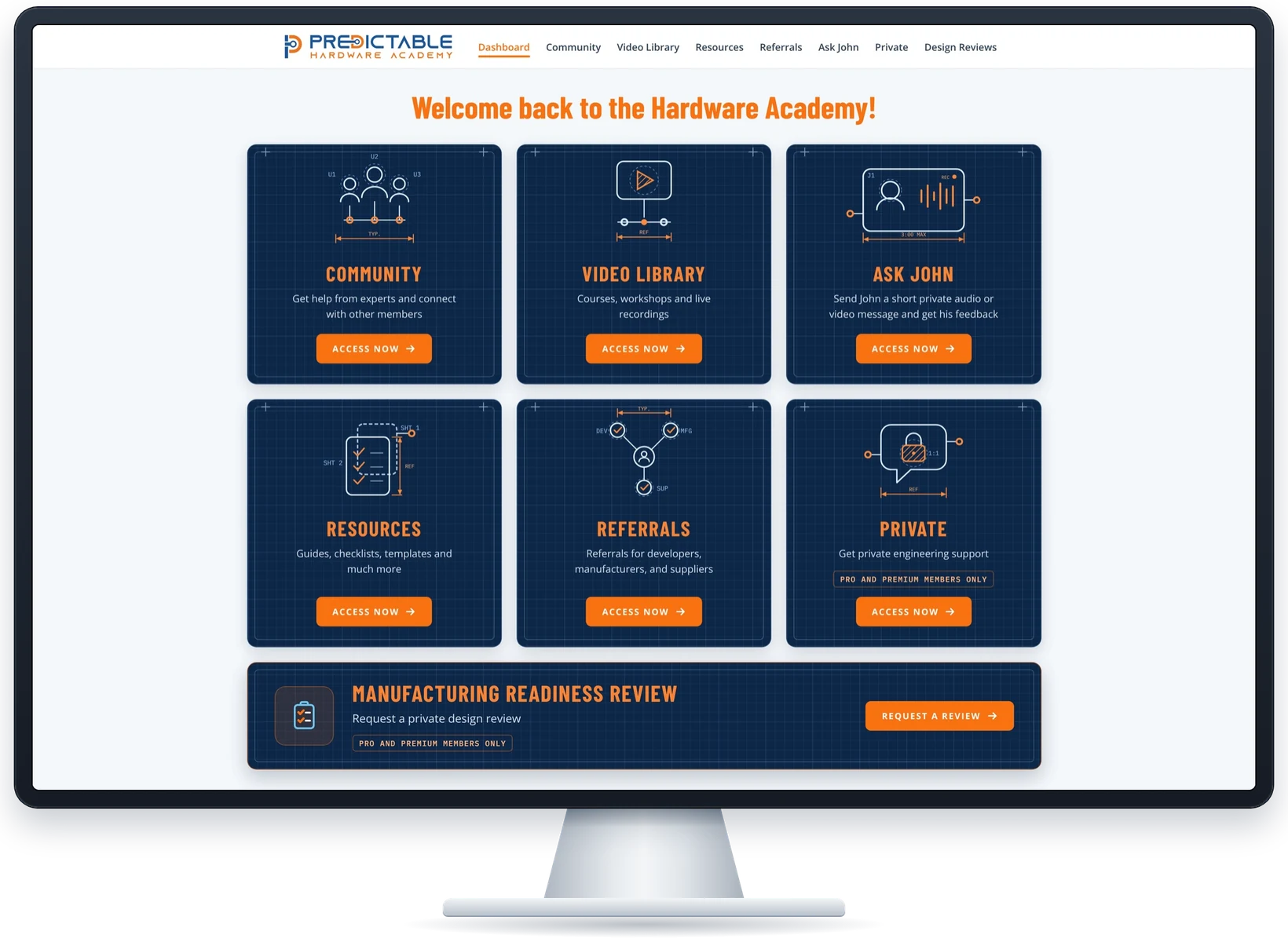
Bringing a new electronic product from concept to market is like walking through a minefield.
One bad assumption can blow up your schedule, your budget, or your confidence.
Every decision, from component selection to certification to validation and funding, has ripple effects, and trial and error is the most expensive way to learn.
Hardware mistakes don't just cost money, they kill momentum.
What you need isn't another course or consultant. You need a team of engineers and product experts who've done it before, guiding your decisions and keeping you out of trouble.
That's what the Hardware Academy gives you, a complete support system of experts and peers who've been where you are and know how to move fast without breaking things.
"Biggest bangs for my buck. No fluff, just honest advice that saves time and money."

Lucas Schulte
Academy member
Meet Your Guide: John Teel

Hey there, I'm John Teel.
I spent over a decade designing microchips at Texas Instruments. My chip designs are in devices from Apple, Intel, and others. In fact, you likely own a device with one of my chip designs.
At TI, no design ever shipped without a room full of experienced engineers reviewing it first. That was just how serious hardware got built.
Then I left to launch my own electronic product from scratch. I got it manufactured and into hundreds of retail stores across the U.S. and Canada, including chains like Walgreens.
But it took longer than it should have, cost more than it needed to, and I made mistakes I could have caught earlier if I'd had the kind of outside perspective I took for granted at TI.
Those experiences shaped everything I do now.
Since 2015 I've been helping people like you bring new electronic products to market without costly trial and error.
Not just the technical side, but funding, market validation, manufacturing, and certification that trip people up just as often.
Inside the Hardware Academy, you get direct access to experienced engineers and my honest feedback at every stage, so you're never figuring it out alone.
You can even send me private video messages to get my advice and feedback on your project (see below).
Ask John your question via private video:
Featured In








“John’s track record was the best in our group. His projects always ran smoothly.”

Apple engineer
Jamie Langlinais
(formerly at TI)
- Over 3,000 people helped since 2019
- 28,700 posts in design discussions
- 40+ courses and workshops
- Members on every continent
Why most hardware products fail
(and how to prevent it)
I've watched hundreds of hardware products up close
And the ones that fail usually don't fail for just one reason. They fail because founders only saw one type of risk while the others blindsided them.
The engineer who builds a great product but never validated whether anyone would actually buy it.
The entrepreneur who pre-sold thousands of units but didn't realize the design couldn't pass certification.
The founder who nailed the design and proved demand, but ran out of cash because they funded production out of their own pocket.
I see these all the time.
That's why the Academy helps you reduce all three types of risk that kill hardware products:
Technical risk: The design that can't be built. A lot of founders pick the wrong components, miss certification requirements, or end up with a design that can't actually be manufactured reliably.
Inside the Academy, our engineers help you catch these issues before they get expensive, from component selection to manufacturing to certification.
MEMBER WIN
One startup's product failed FCC conducted emissions testing on the very first pass.
The culprit was the off-the-shelf USB charger powering it, which carried FCC and CE markings but had no real test data behind them.
After our finding, they swapped in a properly certified charger with published compliance data, sent it back to the lab, and passed.
A logo printed on a part means nothing without the test report to back it up.
Market risk: The product nobody buys. Too many founders build something without ever proving that people will actually buy it. And most assume they need a finished prototype before they can do any real validation.
That's one of the biggest myths out there. You'll learn how to validate your product from the earliest stages, long before you have a finished prototype.
MEMBER WIN
One member, working solo on a niche outdoor product, opened a simple "notify me when in stock" list before launch.
It grew past 2,000 sign-ups against a planned output of only a few hundred units a year.
With demand proven that far ahead of supply, every remaining question was about getting the hardware production-ready, not whether anyone wanted it.
That's what validating early looks like: you find out people want it before you've spent the money building it.
Financial risk: The self-funded production run. A lot of founders drain their savings or go into debt to fund production when they don't have to.
You'll learn how to fund production without risking your own money, using capital from customers, manufacturing partners, and investors instead.
MEMBER WIN
A member's Kickstarter looked like it was going to fall short. Partway through, the numbers just weren't there.
Then the late surge kicked in, and in the final days the campaign jumped from around $24K to past its $60,000 goal with 320 backers.
That funding meant his customers paid for the production run, not his savings.
Most help out there covers only one of these. The engineering side doesn't understand the market and financial risks. And the business coaches don't understand the design and manufacturing risks.
But for a hardware product, you can't really separate these three. They're all connected. You need people who understand how all of it connects, from idea to launch.
I call this the Predictable Launch Protocol™. At every stage, reduce risk with expert input and real validation instead of rushing ahead alone.
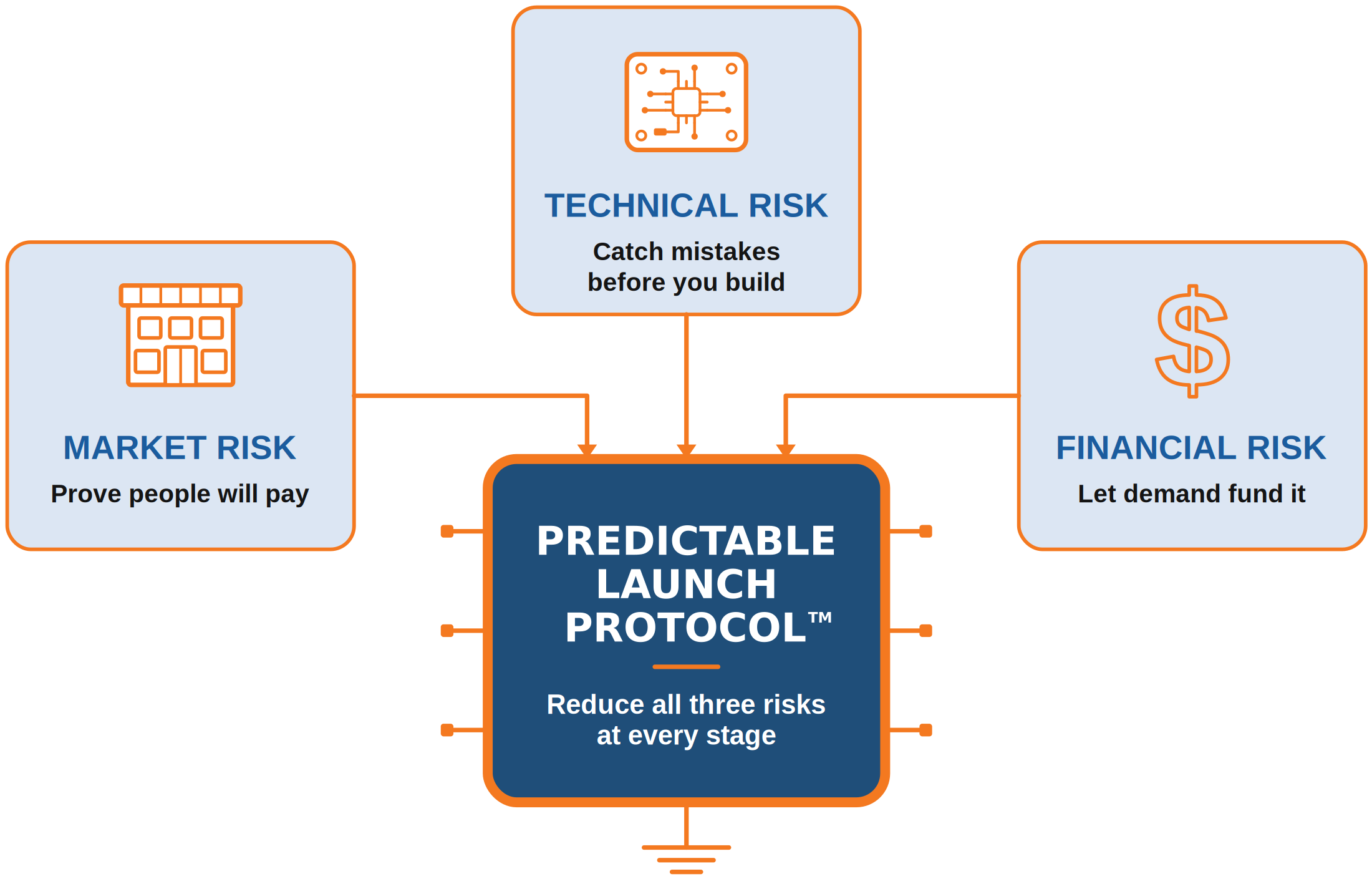
That's why I built the Hardware Academy around all three. I've spent over a decade as a design engineer, then launched my own product and learned the market and financial lessons the hard way. That's what shapes everything inside.
Ronald Wijnsema and the Button+

Ronald spent over four years developing Button+, a modular control panel for smart home systems.
With guidance from the Academy, he launched pre-sales directly from his website. A major Dutch tech publication ran a feature on his product that generated huge engagement, and within days he had sold over $64,000 before manufacturing anything.
That single move reduced his risk in three ways at once.
Pre-selling validated that people would actually pay, funded the production run without draining his savings, and attracted manufacturing partners willing to work with him.
One of those partners was Renaud Anjoran, a manufacturing expert inside the Academy who runs a facility in Asia.
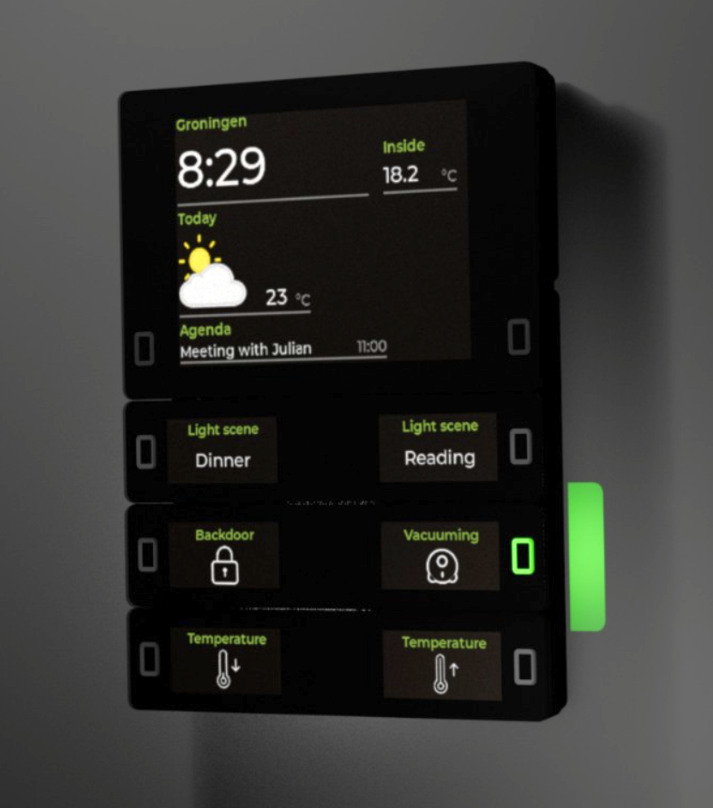
Ronald flew to China to work with Renaud's team on production, and today Button+ is manufacturing and shipping to customers.
Best of all, he's sold out of every production run, and is now expanding his product line.
"I'm over the moon, but it didn’t come easy. The Academy gave me the guidance and feedback I needed to finally make it real."
Ronald's connection wasn't anything rare. Renaud now works with several other members.
In fact, people team up like this all the time in the Academy.
Some work on their products together, some connect with engineers who help them finish their designs, some partner with manufacturers, and at least one has even invested in another member's product.
Expert Support at Every Stage
Get real guidance and technical feedback to ensure your product is manufacturable, reliable, and ready for certification.
The Academy gives you hands-on support from experienced engineers throughout every stage of development.
Guidance at Every Stage (All Plans)
No matter what stage you're at, the biggest question is usually the same: what should I do next?
You post where you are and where you're stuck, and you get a clear path forward from people who've done it before.
That covers questions like these.
What are my next steps to get this manufactured? Which certifications will my product need?
How do I go from my proof-of-concept to a custom design? How do I prove people will buy it before I spend more?
Whether your question is technical or business related, you'll always know what to do next.
MEMBER WIN
A member brought his full plan for a pet product to the Academy, block diagram and margin spreadsheet included, and asked us to challenge it before he built anything.
We helped him simplify the design step by step, from a 32-bit microcontroller down to no microcontroller at all. That also meant no programming.
An expert reviewing his spreadsheet caught that his margins left out some of his real costs, a mistake that would have eaten his profit on every unit.
And when extra features started creeping in, we helped him see that a simple first version was the best place to start.
The result was a simpler and cheaper product to build. Later, at a trade event, he put his prototype in front of his target customers and came away with the validation to keep going.
His reply after all that pushback:
"Always easy to give praise, much tougher to challenge the thinking. So for this, thank you!"
Design reviews are one of the most valuable parts of that support because they catch issues early and prevent expensive redesigns.
The level of design feedback depends on your plan:
Community Design Reviews (All Plans)
With the Standard plan, you’ll have access to Community Design Reviews in our forum.
Share your design and receive guaranteed feedback from our expert engineers and fellow community members. Other members learn from every review too, and you'll learn from theirs.
And you never have to reveal anything proprietary about your product to get this feedback. Your schematic and your components are just building blocks that say almost nothing about what you're actually building.
MEMBER WIN
A member brought a power management board in for review before ordering fabrication, and the schematic looked clean.
Then one of our engineers caught that his current-sense resistors were wired in parallel with the supplies instead of in series. That's 5V across 0.1 ohms, a dead short demanding 50 amps the instant the board powers on.
That same review also caught a shutdown signal wired to the wrong regulator. Both of these fixes cost nothing, because no board existed yet.
Manufacturing Readiness Reviews (Pro and Premium)
The full formal design review. We evaluate whether your product can be manufactured, tested, certified, and scaled, covering roughly 100 checkpoints including manufacturability, reliability, and EMI.
You receive a complete written report of our findings. Pro includes one review per year and Premium includes one every quarter (four per year), which you can use across multiple products. Both plans also give you unlimited private access to our engineers for design feedback and questions throughout development.
MEMBER WIN
A member had two products in volume production, and they came with a costly pattern of failures.
5% of boards were failing at the factory, and about 1% were failing once they got into customers' hands, all on a power circuit that matched the datasheet.
Our engineers went through the design and found no problems. Instead, the evidence pointed at the chip itself, since the chip used gets cloned a lot, and he had no control over where his factory was buying them.
At volume, random failures in a correct design usually point back to the parts. And catching sourcing and manufacturing-scale risks like that before a production run is exactly what these reviews exist for.
Click below to see all of the checks included in our Manufacturing Readiness Reviews:
You get a team of experts:

John Teel

Avinadad Alonso

Dave Millman

Renaud Anjoran

Alex Berrou

Francois Girardin

Martin Sunstrum

Anirban Raha

Bill Whitlock

Ray Crampton

Craig Rettew

Larry Nelson

Mike Morena

Max Wisten

Christian Theill

James Passmore
Some of the people above don't even work for me...
They're expert members who just enjoy helping others like you.
For example, Dave Millman is an MIT engineer who has helped hundreds of people succeed with their products. He even consulted for Steve Wozniak on a universal remote control, Woz's first product after leaving Apple.
Then there's Renaud Anjoran, who runs his own manufacturing company in China. He also manufactures several members' products.
Or take Bill Whitlock, who spent 25 years running Jensen Transformers, one of the most respected names in pro audio. Members lean on him for analog, power, and audio help.
All three of these guys joined within the first year of the Academy opening in 2019, and they've stuck around ever since.
My staff provide the guaranteed reviews and private support. But the room around them is full of people like Dave, Renaud, and Bill.
How the Academy helps you succeed:
Here's what that team helps you do at every stage:
Reduce your technical risk...
- Expert design reviews from our engineers to catch issues before production
- Select the right components and technologies for production
- Make sure your design can actually be manufactured
- Simplify your product to lower development and setup costs
- Reduce or even eliminate expensive certifications
Reduce your market risk...
- Honest feedback on your product idea and feasibility
- Discover how to actually prove your product will sell
- Build your audience before launch
- Improve your chances of crowdfunding success
Reduce your financial risk...
- Know where to spend and where to save
- Learn how to fund production without draining your savings
- Get honest feedback on quotes, timelines, and designs
Work with the right people (and avoid the wrong ones)...
- Referrals to trusted developers and manufacturers
- Learn how to spot and avoid dishonest vendors
- Connect with other founders and engineers who are building real products right now
- Find collaborators, partners, and even manufacturers among the members themselves
MEMBER WIN
One startup committed to a Bluetooth module that was pre-certified and marketed for wearables.
Partway through development, they found out its FCC grant said it couldn't be used any closer than 20 cm from the body, which left them with a wearable that legally couldn't be worn.
So our experts reset the whole premise. A module's pre-certification only covers the conditions of its grant, not your product.
From there they laid out the real path forward, including the classification detail that decided whether an expensive SAR test was even needed.
All of it got caught and rerouted before a dollar of certification money was spent.
Your complete video library:
Over 40 courses and workshops, plus dozens of shorter videos, on everything from PCB design to certifications to manufacturing to market validation and sales.
Click here to see all courses and workshops
- 01Design an ESP32 Board with Battery Charger Using KiCad
- 02Design Your First Microcontroller Board
- 03How to Design Your First PCB (Using KiCad)
- 04New Methods for Low-Cost Injection Molding
- 05How to Design a Custom ESP32 PCB (4 Hours)
- 06From Concept to Prototype to Market for Your New Electronic Product
- 07Most Common Business Mistakes Made by Hardware Entrepreneurs
- 08How to Validate Product-Market Fit
- 09Design Your First PCB Boot Camp
- 10Introduction to Firmware Programming for STM32 Microcontrollers
- 11How to File a U.S. Provisional Patent Application (PPA)
- 12Development Strategies, Funding Options, and Estimating Costs
- 13Mechanical Enclosure Design
- 14Introduction to Mechanical Design
- 15Low-Volume Manufacturing Strategies and Technologies
- 16Product Design Masterclass: From Start to Custom Prototype
- 17Setting Up a Low-Risk Supply Chain in China
- 18Enclosure Design, Prototyping, and Manufacturing
- 1912 Layers of IoT Cloud Infrastructure
- 20How to Build Reliability Into Your Product Design
- 21How to Find and Meet Customers
- 22How to Protect Your Intellectual Property in China
- 23Introduction to Bluetooth Low-Energy
- 24Introduction to PCB Manufacturing
- 25Introduction to Power Management Design
- 26Introduction to PCB Design Using KiCad
- 27Introduction to 3D Printing
- 28Selecting the Wireless Technology for Your New Electronic Product
- 29How to Order Printed Circuit Boards
- 30How to Build a Hardware Company, Not Just a Hardware Product
- 31Understanding Certifications and Regulatory Requirements
- 32How to Design Your Own Custom Printed Circuit Board (PCB)
- 33Beginner’s Course: Introduction to the Arduino
- 34How to Design a Custom ESP32 PCB Using KiCad
- 35How to Design for Injection Molding
- 36Introduction to 3D Modeling
- 37How to Estimate the Manufacturing Cost for Your Product Before You Develop It
- 38How to Talk to Customers
- 39Introduction to Online Marketing and How to Build an Audience
- 40How to Define Your Target Market and Find Your First Big Buyers
- 41How to Define and Validate Your Minimum Viable Product (MVP)
Every question gets an in-depth answer from an expert!
Inside the Academy community:
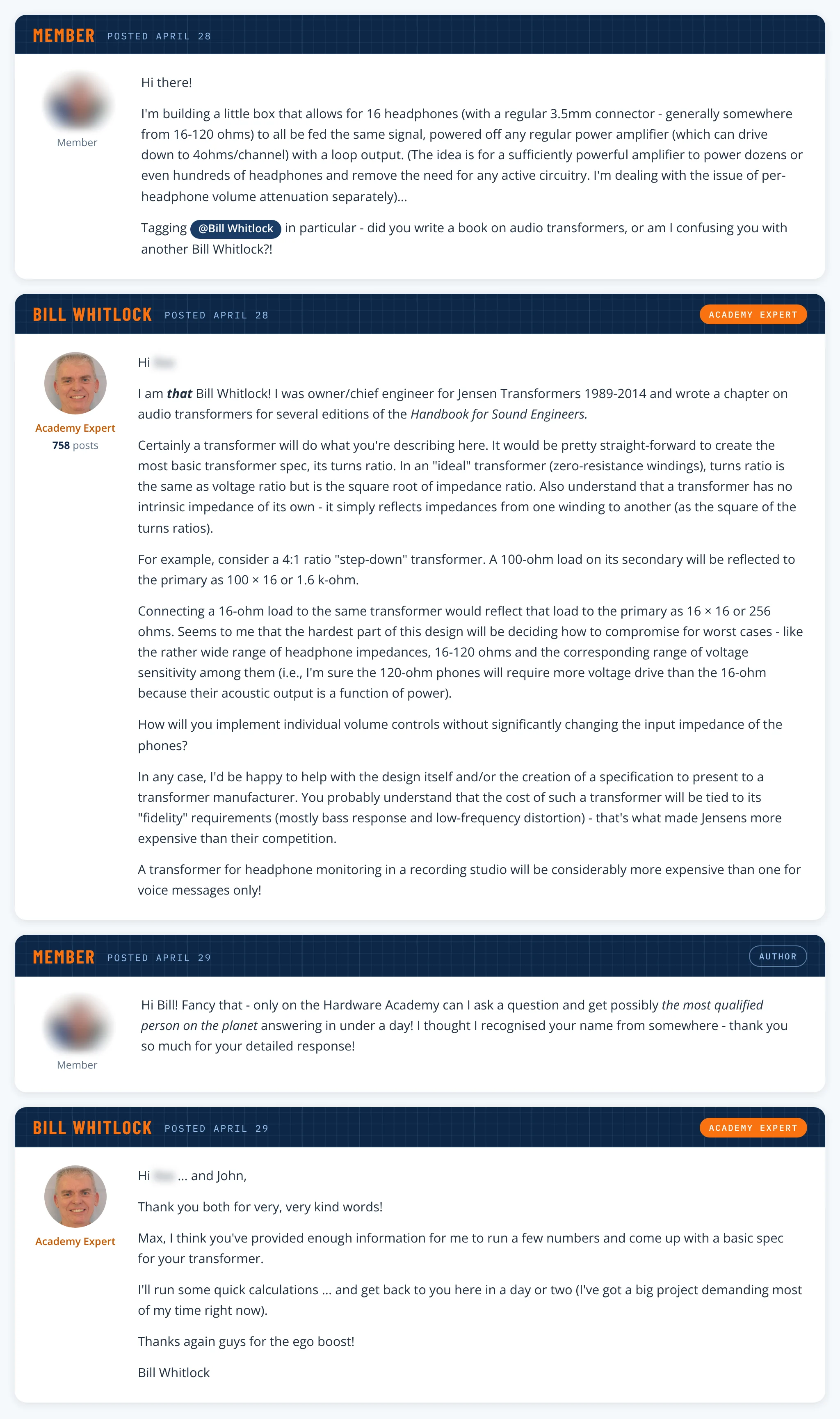
"Only on the Hardware Academy can I ask a question and get possibly the most qualified person on the planet answering in under a day!"
- Academy member (see screenshot below)
MEMBER WIN
A member got the fourth revision of his board back, and USB to the ESP32-S3 was completely dead, even though revision three had worked fine.
He posted his layout and said it was "a problem that has me stumped." One of our engineers walked through the things that actually matter for USB: the differential pair widths, where the ground plane sat in his stackup, and the stubs in his routing.
So he redrew the data lines as a proper differential pair, and the next board came back with USB working just like it should.
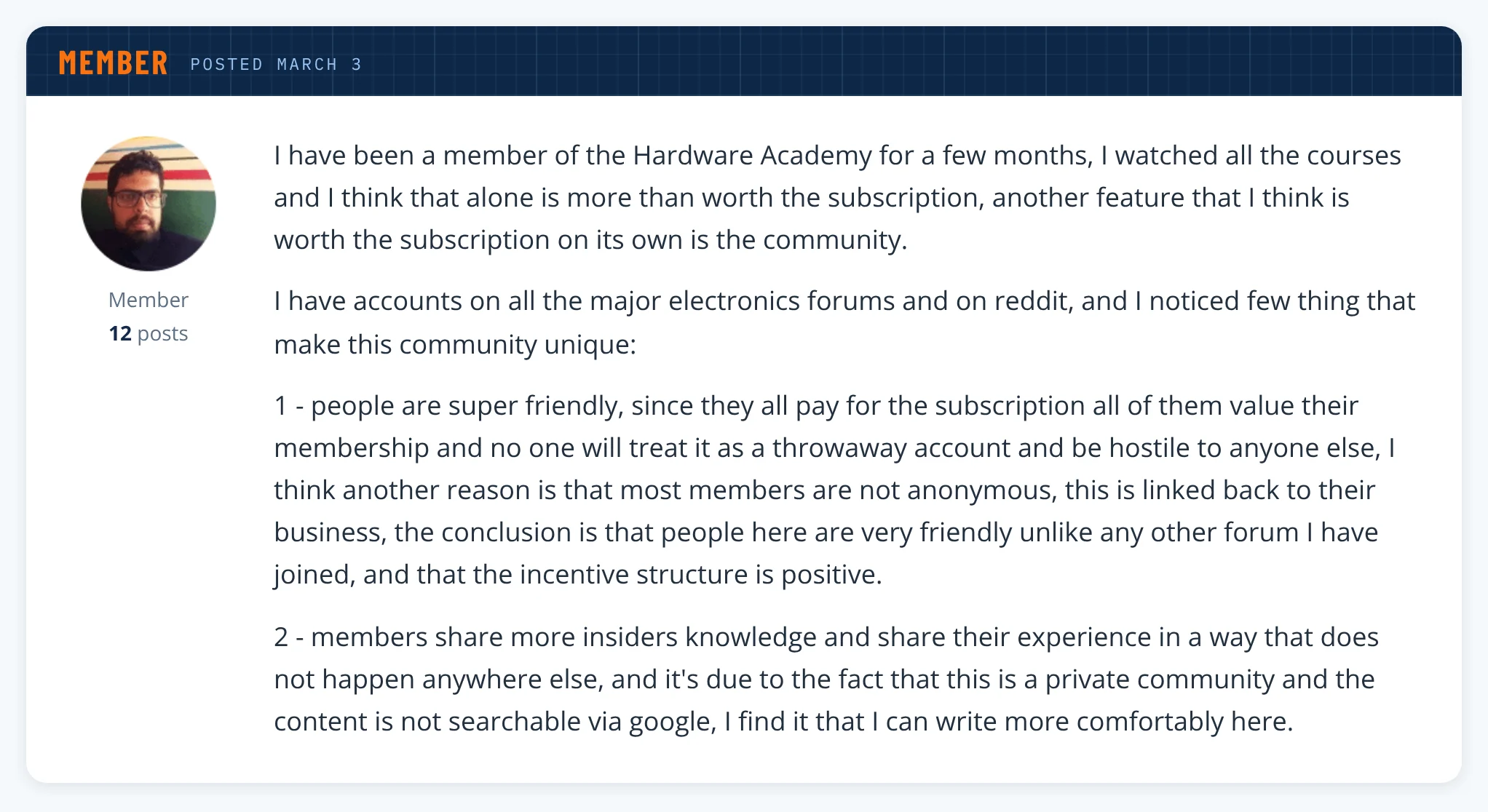
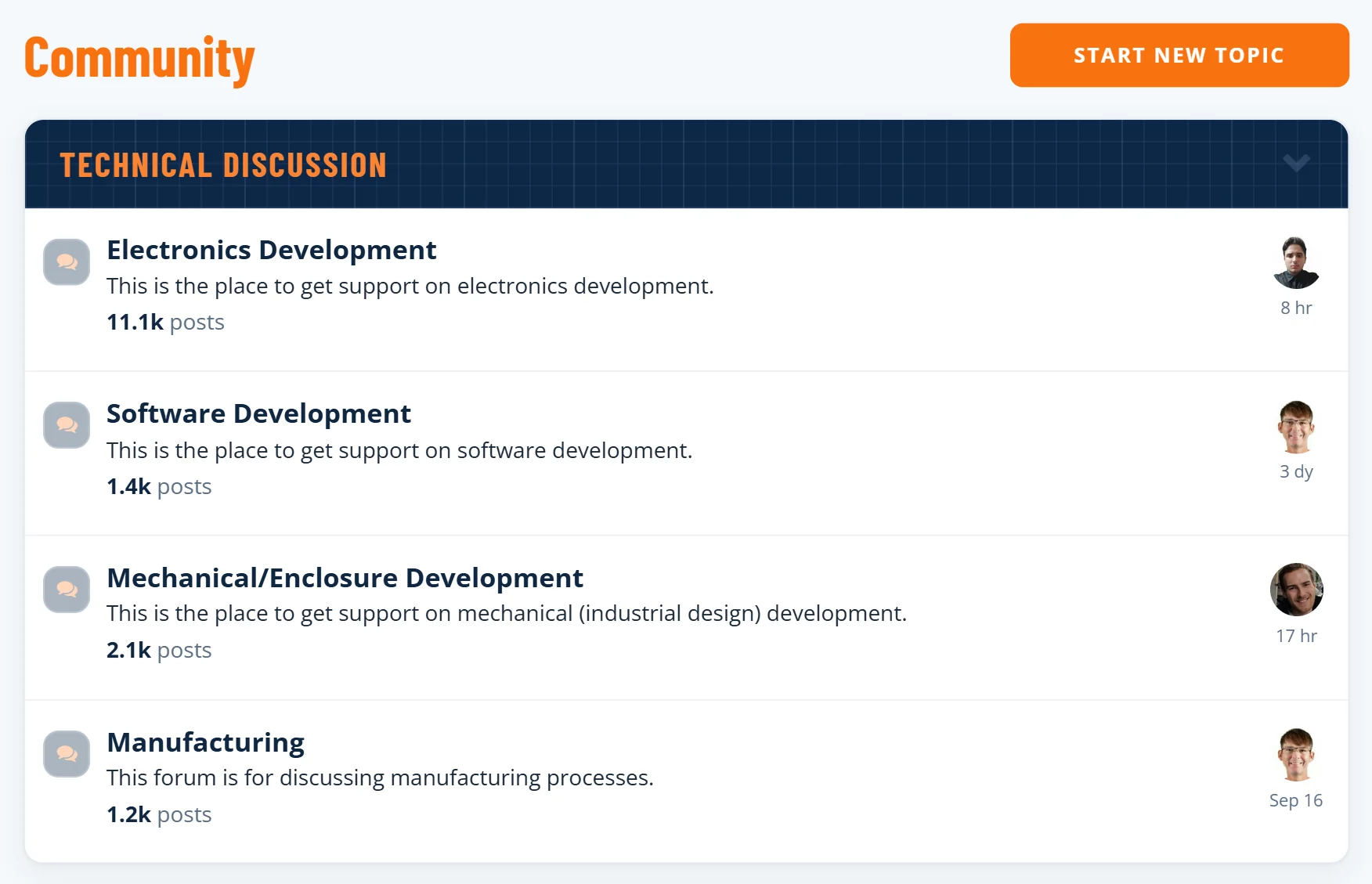
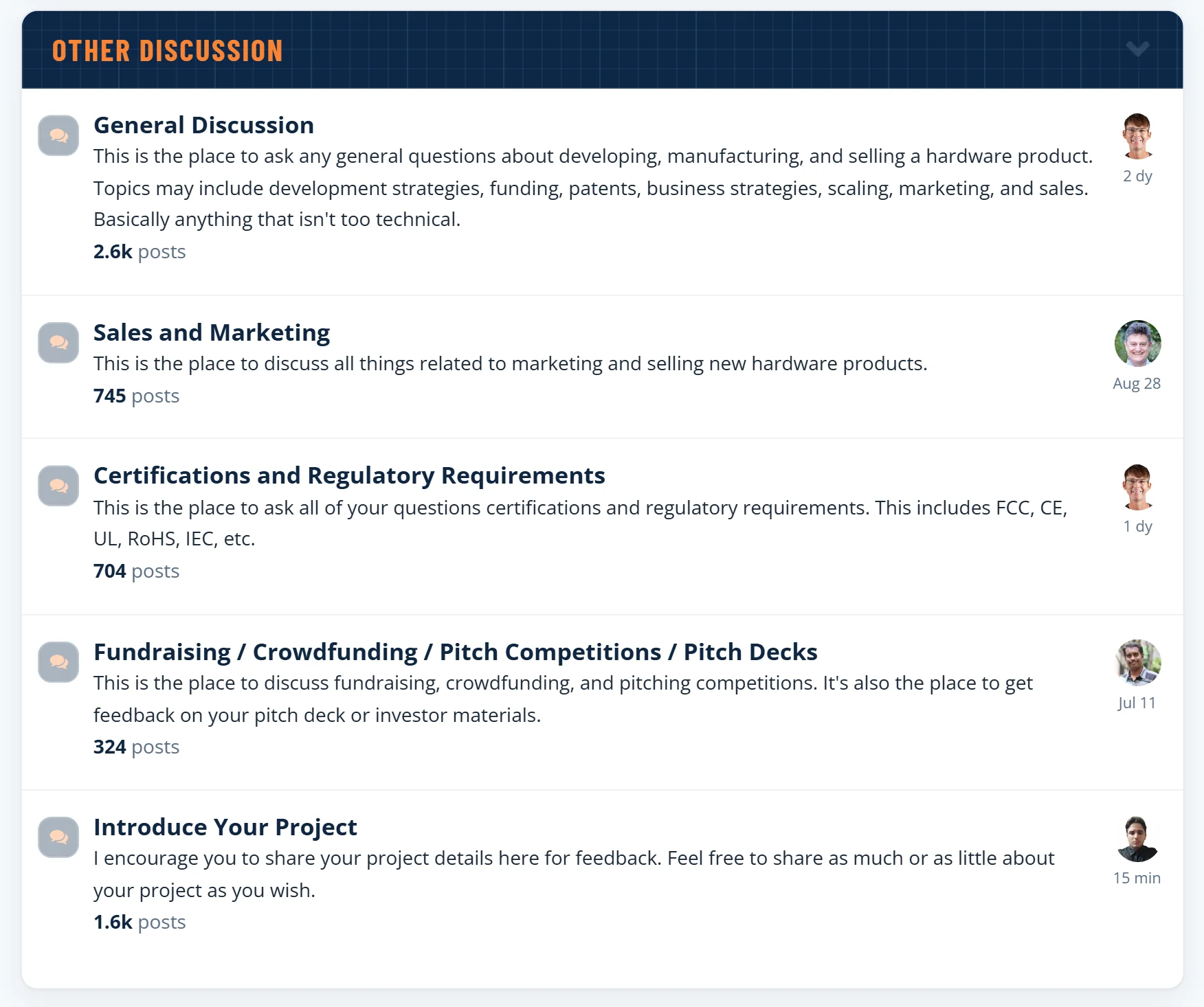
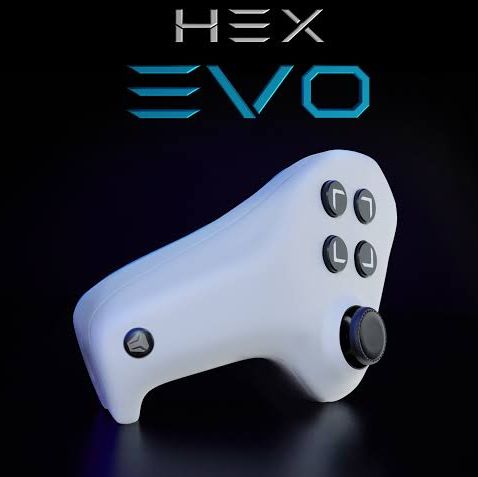
Nicolas Franco and the Hex Evo

Nicolas had a bold idea for a new type of gaming controller called the Hex Evo.
He spent years developing it while inside the Hardware Academy, where he got help with everything from early breadboarding to strategy, marketing, and manufacturing.
When his crowdfunding campaign launched, nerves were high. But just 86 minutes later, he blew past his $40,000 funding goal.
"From figuring out the first prototypes to building a waitlist and launching my campaign, the Hardware Academy supported me every step of the way. I couldn’t have done it without them."
Is It Right for You?
The Hardware Academy is NOT for everyone, and I'd prefer to help you figure out if it’s not right for you BEFORE you join rather than waste your time. So, let’s cut to the chase...
WHO IT IS FOR:
WHO IT IS NOT FOR:
“I was hesitant joining…but immediately all those worries were gone. Worth every penny. I saved myself tons of headaches.”

Erik Hunter
Academy member
You're not too early, and you're not too late...
Wherever you are right now is the right time to start.
Here's why waiting costs you either way.
Most people tell themselves they'll join once they're further along, once the idea feels solid, or the prototype's working, or they've already got a product in hand.
And then there are the people on the opposite end, the ones who figure they're past the point of needing the Academy. They've got a working product, the hard part's behind them, and it's smooth sailing to the finish from here.
I get the instinct, but it's backwards in both directions. The people who think they're too early and the ones who think they're too late are usually making the same mistake at opposite ends.
The decisions that are most expensive to undo start early, and they keep coming at every stage after.
So every month you put this off is another month of those calls made without a second set of eyes. And you don't get those months back.
"I'm still at the idea stage, so it's too early to join."
That's actually one of the best times to join, not a reason to wait.
When you're still weighing directions, the right input helps you pick the idea worth pursuing and spot the risks before you've sunk months into the wrong one.
It's far cheaper to get clarity now than to discover the problem after you've built around it. The earlier you catch it, the less it costs.
MEMBER WIN
A member came to us early with an ambitious, feature-packed plan for an assistive sports product.
Two replies from our experts got him to think hard about the complexity and failure rates he hadn't planned for, and he cut the riskiest part of the design before spending a cent building it.
"Just those two alone were worth several months' worth of the Hardware Academy monthly membership cost, to me, particularly as they helped me identify a number of blind spots."
"I'll join once I've finished my prototype."
There are really two prototype stages: the proof-of-concept you build from dev kits, and the custom design that follows.
A lot of people assume the Academy is for that later custom stage, so they wait. But the decisions you make in your proof-of-concept directly shape the custom design, things like your component choices and the core technology you end up committing to.
Getting experienced eyes on it before you've locked those in is how you avoid carrying an expensive mistake forward. Earlier is always cheaper regardless of the prototype stage.
"I already have a working product, so I'm past the point of needing this."
A working prototype is where the next set of expensive problems begins, not where the risk ends.
Things like certification, design for manufacturing, design for testing, and scaling to volume are where products that work perfectly on the bench fail in production, or rack up costs that should have been designed out earlier.
Having someone experienced review your design before you commit to tooling, test, and a production run is how you avoid the failures that cost the most, the ones that show up last.
Even at these later stages, fixing problems now costs less than after you've shipped to customers.
No matter which stage you're at, your membership covers all of them. You're supported the whole way, from idea to production.
Can't I just use AI for this?
You should be using AI. We use it every day ourselves.
AI is extremely useful where being wrong is cheap, things like learning concepts, drafting code, or summarizing datasheets.
But in hardware, the expensive decisions are different. A confidently wrong answer means a board respin, a failed certification round, or a production order you can't undo.
And AI only answers the questions you ask it. The most expensive mistakes in hardware live in the questions you didn't know to ask.
Even the AI design tools are just assistants, not engineers. They catch some issues, but you have no way of knowing what they missed.
So that's where our engineers and product experts come in. They review your whole product and catch those mistakes before they cost you months.
MEMBER WIN
A member's CO2 sensor kept acting flaky, and a ChatGPT debugging session confidently told him to power it at 5V instead of 3.3V.
The problems seemed to go away, so he built his next board revision the same way.
Then the flakiness came back, and the AI's fix had added a second fault of its own: a 5V-powered sensor with 3.3V logic on its data lines.
Two board revisions went into chasing that ghost.
When the design finally came in for review, our engineers tracked down the problem and suggested the correct fix.
The real cause was routing. Power lines for an ultrasonic piezo ran right beside the sensor wiring and coupled noise into it.
So the voltage was never the problem, and the datasheet had allowed either one all along.
A fix that works for reasons you can't explain is just a failure waiting to come back.
Do I have to reveal my product idea to get help?
No, you don't. Getting help with your product reveals far less than you think.
Think about a smartphone. It has a CPU, a touchscreen, a battery, WiFi, Bluetooth, GPS, an accelerometer, a camera, and a speaker.
That list could describe hundreds of completely different products. Nothing in it tells you it's a smartphone.
Your product works the same way. Its components are just building blocks.
So you can get your schematic reviewed, your layout checked, and your component questions answered without anyone knowing what you're actually building.
The same goes for the nontechnical questions, like what your next steps should be, how to validate demand, or how to approach your marketing.
You can usually ask those without giving anything away either.
And if you're ever unsure how to ask something without giving anything away, you can always message me privately first and I'll help you word it.
The Academy is also nothing like the open internet. Only members can see it, and none of it is publicly searchable.
You can even participate anonymously if you want to.
And when you want experts to see the whole picture, concept included, the Pro and Premium plans give you private engineering support protected by an NDA.
How the Academy Is Different...
"The Hardware Academy has built in vetting of people you can go to for help and was truly a life saver for us."
Elliot S.
Academy Member
To launch a product, you’ll need engineers, consultants, attorneys, manufacturers, and more.
But here’s the problem: most of them get paid whether you succeed or not.
In many cases, their incentives reward complexity instead of real results.
- A patent attorney profits if they convince you to file.
- An engineer earns more by over-engineering your design.
- And invention firms just say what you want to hear so they can extract more from you.
The Hardware Academy is different.
Our engineers don’t just give advice, they review your actual designs to make sure your product is ready for manufacturing.
I don’t sell design services or take commissions on referrals. My only incentive is to help you succeed. If I don’t, you’ll just leave. Simple as that.
Your Academy membership gives you honest, unbiased advice from someone who’s been through it and genuinely wants your product to succeed.
| Do It Yourself | Hire Consultants | Recommended Hardware Academy | |
|---|---|---|---|
| Cost | Low upfront, but costly mistakes | $150+ per hour, adds up fast | One low monthly fee, paid for by the mistakes it prevents |
| Risk Coverage | No experienced guidance on any risk | Each risk needs a separate specialist | Design reviews plus market and financial guidance |
| Incentive Alignment | You care the most, but lack the experience | Paid whether you succeed or not | Recurring model keeps us invested in your progress |
| Speed | Slow trial and error, likely with rework | Fastest, if your budget allows | Fast async help, not a full-time hire |
If you're like me you've already spent endless hours scouring the internet for answers. It's tough to know where to even start.
Now I'm surrounded by talented ambitious individuals who love to help others. They help motivate you and hold you accountable.

Kris Christopher
Academy member
31-Day Money-back Guarantee
Why 31 days? Because I'd rather give you an extra day, so even a monthly rebill is fully covered. I take the risk out of joining, like the Academy takes the risk out of your product.
Three ways to get expert help with your product:
Every plan gives you the full video library and the community.
Standard is where you get your questions answered and your design reviewed by experienced engineers and product experts in the community.
Pro adds unlimited private engineering support for one product at a time, one Manufacturing Readiness Review per year, and full design confidentiality.
Premium gives you unlimited private engineering support across multiple products at once, and adds a full Manufacturing Readiness Review every quarter.
STANDARD
Pay only
$147
per month
Guidance at every stage from a team of experts
Personal advice from John Teel
Community design reviews
All courses and workshops (40+)
Masterclass: From Concept to Market
Thousands of design discussions
Resources and referrals
Active member community
PRO
Pay only
$997
every 3 months
(that's about $332/month)
Everything in Standard plus:
Unlimited PRIVATE engineering support (one product at a time)
One full Manufacturing Readiness Review per year*
Full design confidentiality (protected by an NDA)
PREMIUM
Pay only
$1,497
every 3 months
(that's about $499/month)
Everything in Pro plus:
Unlimited PRIVATE engineering support (across multiple products at once)
A full Manufacturing Readiness Review every quarter* (four per year, across multiple products)
Full design confidentiality (protected by an NDA)
* A Manufacturing Readiness Review is a 100+ point check of your schematic, PCB layout, and enclosure. It covers manufacturing, certification, EMI, and reliability, and we sell these separately for $997 each.
Recurring payment. Cancel anytime. 31-day money-back guarantee. Your rate never increases while you're an active member.
In hardware, one caught mistake can pay for years of the Academy:
- Redesigns: Thousands of dollars and months of delay
- Failed certifications: $3K to $30K, plus a redesign cycle
- A product that doesn't sell: Tens of thousands in inventory
- One year of the Hardware Academy: $1,764 (12 x $147)
An engineer costs $150+ an hour. The Academy gives you a team of them for $147 a month.

One recommendation cut his PCB prototyping quote from $850 to $100:
"Joining the Hardware Academy just paid for itself! Thank you for your advice, expertise, and encouragement."
Steve K.
Academy member
Frequently Asked Questions
Who is each plan for?
Can I get a design review?
Do you help me figure out my next steps?
Do I need to learn electronics or product design for this to work for me?
Does it matter where I'm located?
Can I get private one-on-one help with my project?
How far along do I need to be with my product?
What type of products are right for the Hardware Academy?
How do you handle confidential information?
How is the Academy community area different?
How are courses structured? Are courses live or recorded?
I don't yet have a product idea, or I have lots of product ideas. Should I join now?
How do I cancel my subscription? Can I rejoin later?
I'm in secretive stealth mode, can I be anonymous?
Is all of the content available straight away or is it time-released (drip fed)?
Can I upgrade and downgrade between plans?
My startup consists of several people, can we all share the same account?
Does the Hardware Academy make any claims to my intellectual property?
Once I join will the price ever increase?
We're pre-revenue, should we join now or wait until we have revenue?
How long does it take to get a reply?
How much time does this take each week?
31-Day Money-back Guarantee
Why 31 days? Because I'd rather give you an extra day, so even a monthly rebill is fully covered. I take the risk out of joining, like the Academy takes the risk out of your product.
Three ways to get expert help with your product:
Every plan gives you the full video library and the community.
Standard is where you get your questions answered and your design reviewed by experienced engineers and product experts in the community.
Pro adds unlimited private engineering support for one product at a time, one Manufacturing Readiness Review per year, and full design confidentiality.
Premium gives you unlimited private engineering support across multiple products at once, and adds a full Manufacturing Readiness Review every quarter.
STANDARD
Pay only
$147
per month
Guidance at every stage from a team of experts
Personal advice from John Teel
Community design reviews
All courses and workshops (40+)
Masterclass: From Concept to Market
Thousands of design discussions
Resources and referrals
Active member community
PRO
Pay only
$997
every 3 months
(that's about $332/month)
Everything in Standard plus:
Unlimited PRIVATE engineering support (one product at a time)
One full Manufacturing Readiness Review per year*
Full design confidentiality (protected by an NDA)
PREMIUM
Pay only
$1,497
every 3 months
(that's about $499/month)
Everything in Pro plus:
Unlimited PRIVATE engineering support (across multiple products at once)
A full Manufacturing Readiness Review every quarter* (four per year, across multiple products)
Full design confidentiality (protected by an NDA)
* A Manufacturing Readiness Review is a 100+ point check of your schematic, PCB layout, and enclosure. It covers manufacturing, certification, EMI, and reliability, and we sell these separately for $997 each.
Recurring payment. Cancel anytime. 31-day money-back guarantee. Your rate never increases while you're an active member.
In hardware, one caught mistake can pay for years of the Academy.
Still wondering if this is for you?
Send me a message below and I'll reply by video.
This video chat feature is also available inside the Academy.
Already a member? Here's the login page (please bookmark it): https://thehardwareacademy.com/login